
Dance Movement Psychotherapy, DMP, is a creative therapy that puts the body and body movement at the centre of therapeutic exploration, be that sensations, gestures or more expansive expressive use of body parts or the whole being. DMP focuses on the body, on our patterns of moving, being and relating, as intrinsic and extrinsic to our means of communication, utilising the link between body/mind/spirit to help understand how what we do impacts and affects our thoughts and feelings – and vice versa. There are many examples in our language and culture that reflects this link, consider phrases as “they’re a bull in a china shop” describing someone who crashes through other’s sensitivities without empathy or maybe “you could have knocked me down with a feather” when verbalising a sense of surprise or shock that stops us in our tracks, leaving us feeling off balance. I’m sure you can think of more.
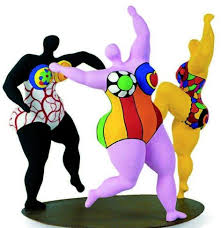
Photo of a ‘Nanas’ sculpture by the late artist Niki de Saint Phalle, who created cheerful, energetic, and powerful figures representing voluptuous women who portrayed femininity and motherhood. Source: Guggenheim, Bilbao.
Source: Guggenheim, Bilbao.
How DMP can help
Creative arts therapies differ from purely verbal based therapies as they integrate expressive activities to help clients access unconscious thoughts and feelings they may not have the words or emotional vocabulary to express verbally. This may be due to age and developmental stage, with children for example, or because the feelings or associated thoughts are too distressing or uncomfortable to frame with words. Using creative approaches can enable clients to bring these to a state of consciousness where they may be explored, examined, accepted and integrated, all within a safe, contained, supportive environment. Purely verbal therapy can sometimes feel too direct whereas the more indirect exploratory approach afforded by creative methods can enable clients to view more challenging aspects of their lives and bring these into focus and from there, address and reflect, gain awareness, and understand what is going on for them.
DMP uses the body as a key tool for this process, although other creative elements may also be encouraged, including art, music, roleplay, verbalisation and play. ‘Dance’ is a bit of a misnomer, as a DMP does not teach a client to dance: rather dance is used to describe an improvised, expressive exploration where sensations or images initiate and guide the movements made – however small, subtle or tentative.

